Information about the closure of the Graduation Tower
For visitors
Starting on 6 October 2026, the Graduation Tower in St Kinga’s Park will remain closed until further notice.
You can find the latest news and changes on our websites.

blog.category For visitors
Added on:
Kopalni Soli Wieliczka
The Saltworks is one of the key facilities in the Mine – its task is to evaporate salt from the brine. Interestingly enough, the history of the Wieliczka Saltworks dates back to the Middle Ages. How has the technology changed over the years?
To begin with, let us first explain what salt evaporation actually is. In short, it is a way of producing salt by evaporating it from brine – water solutions of salt. The name – Saltworks – refers to all the devices and equipment used in the process. As of now, Wieliczka is equipped with a very modern saltworks; however, its history started many years ago... Salt production over the years.
In order to tell the full story of salt evaporation in Wieliczka, we must go back to the Middle Ages… and even to prehistory, since even then people knew about this way of producing salt and used it, employing a system of vessels, grooves and evaporation pots made of clay set over the hearths. In the 11th century, clay vessels were replaced by metal pans.
The rise of the vacuum saltworks
The development of the salt evaporation technology picked up pace in the early 20th century. In 1910 the construction of a new saltworks started in the “Wieliczka” Salt Mine, at the initiative of Antoni Müller, who tried his best to prevent the mine shutting down, as the good-quality salt was running out. How did he manage to do that?
Müller was an engineer, senior mining councillor and head of the Saline Board in Wieliczka. With the help of Jan Jurkiewicz, he developed a modern method of dissolving salt in leaching towers – a solution that was cheaper than building a new mine.
The modern vacuum saltworks was officially opened on 26 November 1913. It was supposed to produce as much as 30,000 mg of salt per year; however this was only achieved in 1927. Interestingly, the brewhouse was named after Count Wacław Zaleski, who was the Minister of Treasury at the time and gave his consent for this project in 1903.
Further development of the Saltworks
The interwar period brought further changes and improvements. In 1939, the salt production grew to 64,000 mg of salt per year. The Saltworks also functioned during the occupation, but at a lower capacity. Later, it underwent numerous overhauls, which did not change the production technology, and its capacity increased over time.
The Wieliczka Salt Mine Saltworks today
After salt extraction ended, the Saltworks took up the role of a salt water treatment plant for the “Wieliczka” Salt Mine; however, due to poor technical condition of the evaporation equipment and the coal boiler room, in 1999 the decision was made to once again overhaul the plant. It was replaced by a modern and ecological Salt Water Treatment Plant, which resumed operations in 2003.
It is worth pointing out that the launch of the new Treatment Plant not only reduced the costs of brine disposal and ensured the safety of the historic part of the mine, but also contributed to better protection of the environment - as the load of salt entering the environment is now significantly lower.
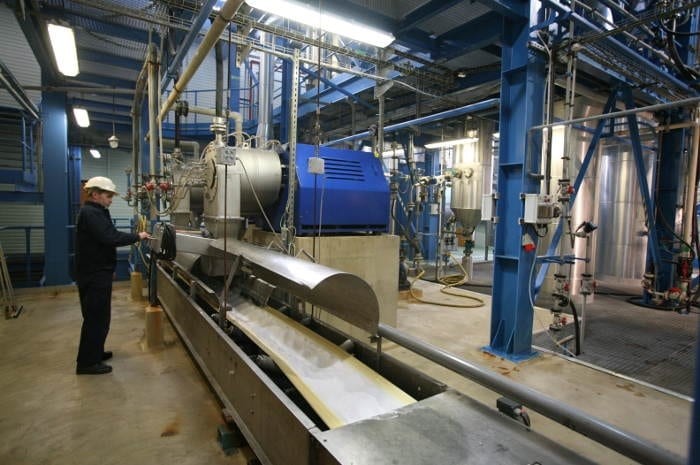
The Wieliczka Salt Mine Saltworks.
Have you ever wondered what a miner's job is like? If you would like to see for yourself if you can handle all the tasks, you should pay a visit to the Miners’ Route. All tour participants receive a special work outfit, a helmet and a lamp. During the three-hour tour, the participants not only explore underground galleries, but also measure methane concentration, search for and transport salt, mark their way and explore unknown chambers.
It is worth keeping in mind that the “Wieliczka” Salt Mine is about much more than long underground galleries and awe-inspiring chambers – it also features facilities such as the Salt Water Treatment Plant, which perform crucial functions and undoubtedly have a long and interesting history that dates back many years.
Everyone who would like to get to know the mine better should take advantage of the unique opportunity offered by the Miners’ Route, which offers more than just ordinary sightseeing – it is an active expedition that will stay in the memories of every participant who will dare to explore.
For visitors
Starting on 6 October 2026, the Graduation Tower in St Kinga’s Park will remain closed until further notice.
You can find the latest news and changes on our websites.
For visitors
On Sunday, 2 August 2026, the city of Kraków will host the IRONMAN 70.3 competition, which will result in significant changes to traffic organization in Kraków and the nearby town of Wieliczka.
We would like to inform all residents, tourists, and guests planning to visit the Wieliczka Salt Mine about the necessary traffic disruptions related to this major sporting event.
For visitors
The Tourist Route is undoubtedly the most popular tour of the salt kingdom, but it’s of course not the only available one. The Miners’ Route awaits those who are eager to experience something new and put themselves in the shoes of miners. Don’t worry - we’ll help you choose the perfect tour!