Information about the closure of the Graduation Tower
For visitors
Starting on 6 October 2026, the Graduation Tower in St Kinga’s Park will remain closed until further notice.
You can find the latest news and changes on our websites.

blog.category For visitors
Added on:
Kopalni Soli Wieliczka
Brass bands and mines in Poland have a long-standing joint tradition and history. For years, the music played by mine ensembles illustrated the celebrations of major national, church and miners’ holidays. Like many other mines, the “Wieliczka” Salt Mine can also boast its own Representative Brass Band, which has been around since the days of the Austrian Partition and recently celebrated its 190th anniversary.
Go to paragraphs:
The origins of the “Wieliczka” Salt Mine Representative Brass Band date back to the 18th century, when the Austrians founded the first regular tourist route in the underground part of the mine. The year 1830 is widely considered to be the date of the establishment of the first official mining orchestra in Wieliczka, then called the Imperial and Royal Salinary Music Ensemble.
Initially, the musicians were tasked with making sure that the visitors enjoyed their underground journeys. In order to do so, they played for tourists in the Michałowice, Saurau, Dworzec Gołuchowskiego, Józef Piłsudski and Łętów Chambers. What is more, its performances were also a staple during all VIP visits to the mine. During the 1851 visit by Emperor Franz Joseph I of Austria, the Michałowice Chamber was filled with the sounds of Gott erhalte Franz den Kaiser and the famous Radetzky March.
Every week, the brass band gave a concert in the gazebo in Elisabeth Park, known to contemporary visitors as St Kinga’s Park. During the German occupation of Poland, the musicians occasionally played in the courtyard of the Saltworks Castle, and after 1945, they would perform in Wieliczka parks.
These days, Franciszek Czyżowski is widely considered to be the first bandmaster of the Salt Mine Brass Band; however, some sources point to the certain Michał Ahlich as the first Salinen Kapelmeister, who led the musicians from 1831 to – probably – 1845. Roughly until the mid-1970s, the bandmasters of the Representative Brass Band hailed from among the staff of the “Wieliczka” Salt Mine. In later years, the ensemble was led by professional musicians, masters and virtuosos of various instruments.
According to sources, in 1876 the Brass Band in Wieliczka had 29 musicians, while in the interwar period it grew to about 40 artists. Over the following years, the ranks dwindled – in the 1980s, only 17 musicians contributed their skills and time to the Band. In 1988, following the invitation to the European Brass Music Festival in Augsburg, the ranks were expanded to 33 musicians – as a result, the band returned to its size from the interwar period. Starting in 2009, the Representative Brass Band has numbered about 40 musicians.
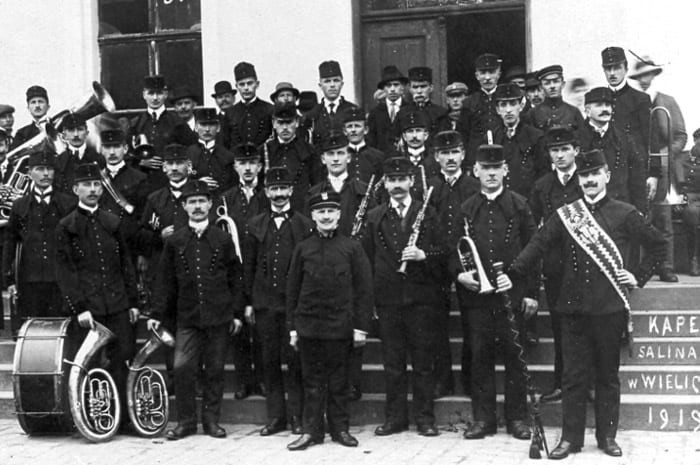
A brass band concert requires instruments – and they are rarely cheap. The original instruments used by the “Wieliczka” Salt Mine Representative Brass Band were purchased in Kraków, at a music store at Floriańska 20, back in 1850. Some were bought in Königgätz and Schönbach. Unfortunately, the destruction of World War II did not spare them – only two original double basses and a violin belonging to a string ensemble associated with the Brass Band survived. New or nearly new instruments were purchased soon after the war. As of today, the instruments are purchased and replaced on a regular basis.
In 1893, musicians received new uniforms – miners' overalls, pants, caps with plumes, caps and ties. Today, the “Wieliczka" Salt Mine Representative Brass Band looks just as amazing as it used to back in the day. All thanks to the uniforms worn by the musicians, which are modelled on miners' official uniforms, as well as the caps with red plumes. The bandmaster stands out, wearing a cap adorned with a red and white plume.
Since 1917, the orchestra rehearsed in the Paderewski Shaft top building. Following World War II, the rehearsals were held in various parts of the city. In 1958, after the demolition of the Paderewski Shaft top building – which is currently being restored to its former glory – the rehearsal hall was moved to the Regis Shaft top building, which was used by the band until 1963 – at that time, the musicians had to move to the Workers' House on Szpunara Street. After a while, they had to move once again – to the northern wing of the Daniłowicz Shaft top building.
For a while, the rehearsals were also held in the Górsko Shaft top, later turned into a warehouse and a library. That was hardly the end of changes – the musicians wound up returning to the Regis Shaft building a couple of years later. These days, the musicians rehearse in the contemporary saltworks building, in a proper rehearsal hall adapted to their needs.
The repertoire of the orchestra comprises more than a thousand pieces, including marches, waltzes, polkas, popular songs, overtures, hymns and film music. The band also boasts an archive of historical scores, including pieces for string ensemble. Some of the oldest scores still in possession of the band include pieces from operas and operettas by Vincenzo Bellini (aria in A-flat major from I Puritani), Gaetano Donizetti (aria from La Favorite), Friedrich von Flotow (overture, romance and finale from Martha oder Der Markt zu Richmond), Giacomo Meyerbeer (Vielka), Giacomo Rossini (recitative and cavatina from Mosé in Egitto) and Giuseppe Verdi (symphony from Nabucco, duet from Attila, and a cavatina from Macbeth). They were purchased in 1849 and 1850.
The history of the miners’ band, which is ranked amongst the oldest active brass bands in Europe, is inextricably linked with the history of the “Wieliczka” Salt Mine as a tourist attraction.
The contemporary orchestra operates and plays under the name of the “Wieliczka” Salt Mine Representative Brass Band. Every single year, the band plays about 100 concerts and performances on average, echoing throughout the underground chambers and resounding on the surface. Each concert at the “Wieliczka” Salt Mine attracts numerous visitors and guests, always ending with thunderous applause. During the performances, brass music aficionados can listen to the various renditions of the classics, including Bach, Schubert, and Strauss, as well as marches and film music.
The music played by the Representative Brass Band also enriches the celebrations of official and religious holidays, as well as mining ceremonies – such as the traditional St Barbara's Day. The concerts also accompany many commercial events held in the salt chambers.
The Brass Band also hearkens back to its pre-war tradition and history by hosting a series of weekly summer music concerts, organised throughout July and August in St Kinga’s Park for several years now. The events are open to the residents of Wieliczka and visitors coming to experience the underground chambers and galleries carved in salt.
The Representative Brass Band is also eager to tackle new challenges. In January 2018, a unique concert, streamed live in social media, was held in the beautiful Jan Haluszka Chamber, 135 metres underground. The concert programme featured numerous pieces from the classic Viennese repertoire and a number of marches, as well as… some more contemporary and entertaining songs.
The skills of musicians from Wieliczka are appreciated not only in Poland, but also abroad, including Buchloe, Augsburg and Salzburg. The orchestra performs at festivals and takes part in numerous high-ranking contests and competitions. Among some of the most important achievements of the Wieliczka musicians are the three top awards at the Echo Trombity Brass Band Festival in Nowy Sącz (2001, 2002 and 2012), as well as 1st place at the International Miners’ Band Competition in Ferropolis.
The “Wieliczka” Salt Mine Representative Brass Band was also awarded the Golden Award at the 8th International Brass Band Festival in Hungary and has recorded several albums.
For visitors
Starting on 6 October 2026, the Graduation Tower in St Kinga’s Park will remain closed until further notice.
You can find the latest news and changes on our websites.
For visitors
On Sunday, 2 August 2026, the city of Kraków will host the IRONMAN 70.3 competition, which will result in significant changes to traffic organization in Kraków and the nearby town of Wieliczka.
We would like to inform all residents, tourists, and guests planning to visit the Wieliczka Salt Mine about the necessary traffic disruptions related to this major sporting event.
For visitors
The Tourist Route is undoubtedly the most popular tour of the salt kingdom, but it’s of course not the only available one. The Miners’ Route awaits those who are eager to experience something new and put themselves in the shoes of miners. Don’t worry - we’ll help you choose the perfect tour!