Information about the closure of the Graduation Tower
For visitors
Starting on 6 October 2026, the Graduation Tower in St Kinga’s Park will remain closed until further notice.
You can find the latest news and changes on our websites.

blog.category For visitors
Added on:
Kopalni Soli Wieliczka
Castles, museums, caves — Małopolska has numerous attractions to offer, with the “Wieliczka” Salt Mine being one of the most interesting sites in the region. Regardless of the route you choose, both the Tourist Route and the Miners’ Route showcase only a small part of the astounding and impressive underground facility. Even though there are many more interesting places in its depths, unfortunately, some of them have to remain hidden from our sight. The Crystal Grottoes are among these inaccessible, yet fascinating places.
Go to paragraphs:
Do you know what a crystal grotto is? The “Wieliczka” mine can boast something truly unique – a system of crevasses and voids filled with clear, regular crystals of halite – the mineral that makes up rock salt, which we refer to as a crystal cave or a crystal grotto.
How were they created? The first crevasses appeared in the Ice Age, during the Pleistocene glaciation, some 1,200 to 950 thousand years ago. Interestingly, studies have shown that the crystals are secondary formations and younger than the salt making up the Wieliczka deposit.
It is worth noting that the crystal grottoes of Wieliczka – namely the Lower and Upper Crystal Grottoes — are the world’s only voids in the Miocene salt deposit overgrown with salt crystals. They can be found in a remote part of the mine, at a depth of about 70 to 114 metres.
The first discovery of the Crystal Grottoes in the “Wieliczka” Salt Mine took place in the second half of the 19th century, more than a century ago. At first, isolated crevasses overgrown with crystals were found by chance, but it was only in the first years of the final decade of the 19th century that intensive exploratory surveys were launched to find them.
To protect the unique accumulations of halite crystals and salt karst formations, as well as to preserve the natural character of the site, the first underground inanimate nature reserve was established in the Grottoes in 2000. The reserve encompasses the Lower Crystal Grotto with a total volume of 706 m³ and the slightly larger Upper Crystal Grotto, with a total volume of 1,000 m³.
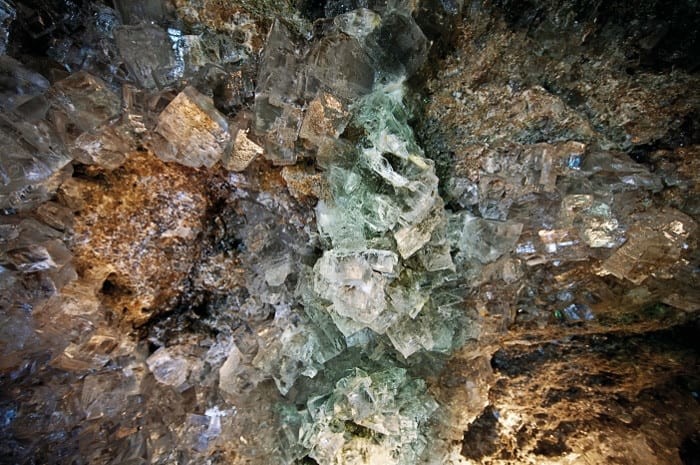
The crystals are very delicate and brittle. Any change in environmental parameters, such as temperature or humidity, can have a negative impact and leave irreparable damage. That is why the reserve is closed and tourists are not allowed to see it – thankfully, the beauty of the grottoes can be admired thanks to photographs.
When it comes to interesting places, Małopolska is second to none – you can find something worthy of note at virtually every corner, and the “Wieliczka” Salt Mine is definitely one of the must-see attractions. Taking a stroll through the chambers and underground galleries can be an unforgettable adventure. Sure – you might not get an opportunity to see the Crystal Grottoes with your own eyes, but the Russegger VI chamber at the Cracow Saltworks Museum features numerous unique and famous clear crystals.
For visitors
Starting on 6 October 2026, the Graduation Tower in St Kinga’s Park will remain closed until further notice.
You can find the latest news and changes on our websites.
For visitors
On Sunday, 2 August 2026, the city of Kraków will host the IRONMAN 70.3 competition, which will result in significant changes to traffic organization in Kraków and the nearby town of Wieliczka.
We would like to inform all residents, tourists, and guests planning to visit the Wieliczka Salt Mine about the necessary traffic disruptions related to this major sporting event.
For visitors
The Tourist Route is undoubtedly the most popular tour of the salt kingdom, but it’s of course not the only available one. The Miners’ Route awaits those who are eager to experience something new and put themselves in the shoes of miners. Don’t worry - we’ll help you choose the perfect tour!